







Industrial procurement teams in Europe operate under zero tolerance for pipeline failure. Water supply networks, HVAC systems, and industrial cooling loops depend on filtration hardware that meets exact regional specifications — and holds up under continuous operational stress. Selecting the wrong factory does not just delay a project. It creates unplanned downtime, failed pressure inspections, and damaged pumps and control valves that cost far more to replace than the strainer itself.
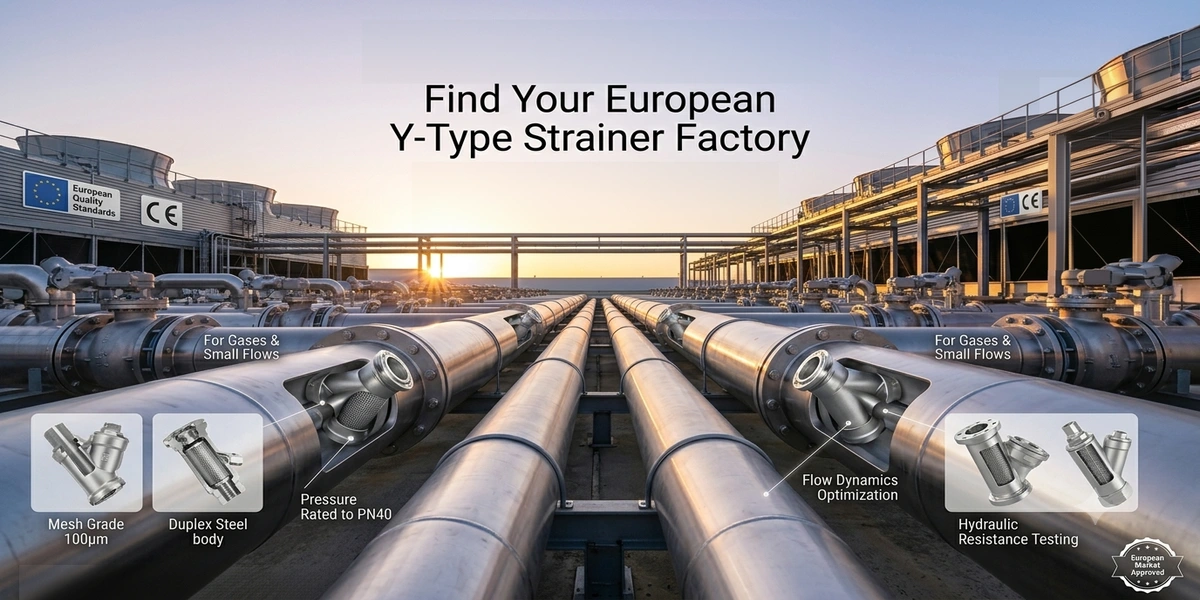
This guide walks through the exact steps to identify a europe y type strainer factory that meets DIN and EN standards for demanding industrial applications.
Step 1: Verify Standards Compliance First
Before evaluating any factory’s catalog or pricing, confirm their standards documentation. European pressure-containing components must conform to EN 1092-1 flange standards and support PN pressure ratings at a minimum of PN16, PN25, and PN40. A factory that cannot produce this documentation upfront disqualifies itself immediately.
Standards compliance protects the entire downstream system. Strainers sit upstream of expensive pumps and control valves, and mechanical tolerances must match local piping specifications exactly to prevent bypass or seal failure under pressure cycling.
What to verify before signing any contract:
- EN 1092-1 flange compatibility across all standard sizes
- ISO 9001 quality management system certification
- Pressure Equipment Directive (PED) compliance for EU market entry
- EN 10204 Type 3.1 material certificates issued per production batch
Step 2: Evaluate Material Capabilities and Certifications
Material selection determines how long a strainer survives in service. Chemical processing plants, offshore energy platforms, and municipal water facilities each expose hardware to different combinations of temperature, pressure, and corrosive media. A cast iron strainer rated for clean water service fails rapidly in chlorine dosing lines or ammonia headers — the material degrades, the housing cracks, and the downstream equipment takes the damage.
Request full material traceability documentation before placing any order. Factories that cannot produce 3.1 material certificates and pressure test reports for every production batch introduce unacceptable supply chain risk.
Material options a qualified factory must support:
- SS304 / 316L stainless steel for hygienic and corrosive service
- WCB carbon steel for standard industrial applications
- Alloy steel and Hastelloy for aggressive chemical media
- PTFE lining for chemical synthesis and metallurgy pipelines
Step 3: Assess Manufacturing Precision and Testing Standards
A reliable factory machines flange faces and threaded connections to ±0.01mm tolerance. This precision guarantees air-tight seals in high-pressure steam and chemical synthesis applications. Factories working to looser tolerances produce strainer screens that sit imperfectly within the housing — allowing contaminant bypass that defeats the entire purpose of the installation.
ISO 5208 air-tightness testing is the minimum acceptable testing protocol. A basic leak check is not equivalent. In a chemical plant, a failed seal on a DN100 strainer can shut down an entire production line for 12 to 24 hours — a cost that dwarfs the price of specifying a properly tested unit from the start.
Minimum manufacturing benchmarks to demand:
- CNC machining to ±0.01mm on all critical dimensions
- ISO 5208 air-tightness testing on every unit
- Full pressure and temperature test documentation per batch
- CAD drawings and dimensional reports available on request
Step 4: Compare Local Suppliers Against Global Manufacturers
Procurement managers regularly weigh italy y type strainer suppliers and other European-based sources against global manufacturers. Local suppliers offer shorter logistics windows and easier communication. Global factories — particularly those in established Asian valve manufacturing hubs — offer vertically integrated production that supports large-scale infrastructure at competitive unit costs.
Chinese factories in mature valve industrial belts manage every production step in-house, from raw material sourcing to final CNC machining and surface treatment. Because the full production cycle stays within one facility, quality control is tighter and pricing remains competitive without cutting corners on EN standards compliance.
Feature | Industrial Grade (YKY) | Standard Retail Strainer |
| Material Options | SS304/316L, WCB, Alloy Steel | Primarily Cast Iron |
| Pressure Rating | Up to PN40 / Class 600 | Limited to PN10/16 |
| Manufacturing Standard | ISO 9001, API, DIN, JIS | Non-standardized |
| Testing Protocol | ISO 5208 Air-tightness | Basic Leak Test |
| Customization | Full OEM/ODM Support | Catalog Only |
| Lead Time | 35-Day Reliable Delivery | Variable / Unpredictable |
Step 5: Check Customization and Technical Support Capability
Standard catalog products do not cover every project requirement. A europe y type strainer manufacturer serving professional procurement teams must support custom mesh sizes, insulation jackets for extreme temperature service, and OEM/ODM configurations for non-standard piping layouts. Pharmaceutical plants require ≤0.8μm surface finishes. Metallurgy lines need units rated for thermal shocks up to 800°C. These specifications fall outside any standard catalog.
Technical support availability directly affects project timelines. A factory without a dedicated English-speaking engineering team creates communication gaps that delay procurement decisions and produce costly specification errors on custom orders. Because of this, always confirm the availability of direct engineering support before committing to a supplier relationship.
Customization capability checklist:
- Custom mesh sizes for application-specific particle retention
- Insulation jacket options for extreme hot or cold service
- OEM/ODM capability for non-standard body configurations
- Dedicated English-speaking technical team for selection and after-sales support
Step 6: Confirm Delivery Reliability and Project Track Record
A 35-day lead time means nothing without a documented delivery performance record. Factories with a 99% on-time delivery rate give procurement teams the schedule certainty that large-scale infrastructure projects require. A single delayed shipment on a critical pipeline project can push commissioning back by weeks and trigger contract penalties.
Evaluate the factory’s track record in sectors that match the target application — chemical processing, energy generation, or municipal water management. Experience in European working conditions reduces specification mismatches and the risk of premature equipment failure in the field.
YKY operates from a major industrial hub with over 20 years of experience serving overseas markets across 30+ countries. Full EN/DIN flange standard compliance, 99% on-time delivery, and dedicated English technical support make YKY a stable long-term procurement partner for European projects.
Bolted Bonnet Steel Gate Valves for the petroleum and natural gas industries, designed for reliable performance in harsh conditions.
Explore Product
Frequently Asked Questions
What certifications does a reliable Europe y type strainer factory need?
A factory supplying the European market must hold ISO 9001 certification and demonstrate compliance with the Pressure Equipment Directive (PED). EN 10204 Type 3.1 material certificates are required for every production batch. These documents confirm that the strainer handles its rated pressure and temperature without structural failure under operational conditions.
How do I know if a global factory can meet European pipeline standards?
Request EN 1092-1 flange dimensional drawings, ISO 5208 test reports, and PED compliance documentation before placing any order. A factory that manufactures to API, DIN, and JIS standards simultaneously has the process discipline to meet European specifications. Audit their QC documentation trail — if material traceability records are incomplete, the factory is not a viable European market supplier.
What is the standard lead time for bulk Y-strainer orders from an Asian factory?
Leading manufacturers maintain a 35-day standard lead time with a 99% on-time delivery rate for bulk orders. This reliability is essential for large-scale infrastructure projects where commissioning schedules are fixed. Confirm the lead time guarantee in writing and request references from European project buyers before finalizing the procurement decision.