











Quick Answer
For gate valve vs butterfly valve selection, three criteria decide the answer: sealing requirement, operating pressure, and available installation space. Gate valves provide metal-to-metal sealing, full-bore flow with near-zero pressure drop, and pressure ratings up to Class 2500. YKY Valve manufactures industrial gate valves to API, GB, DIN, and JIS standards for oil and gas, chemical, and water treatment industries across 30+ countries. 100% pressure-tested before shipment. 100+ global OEM clients served.
What Is the Core Difference Between a Gate Valve and a Butterfly Valve?
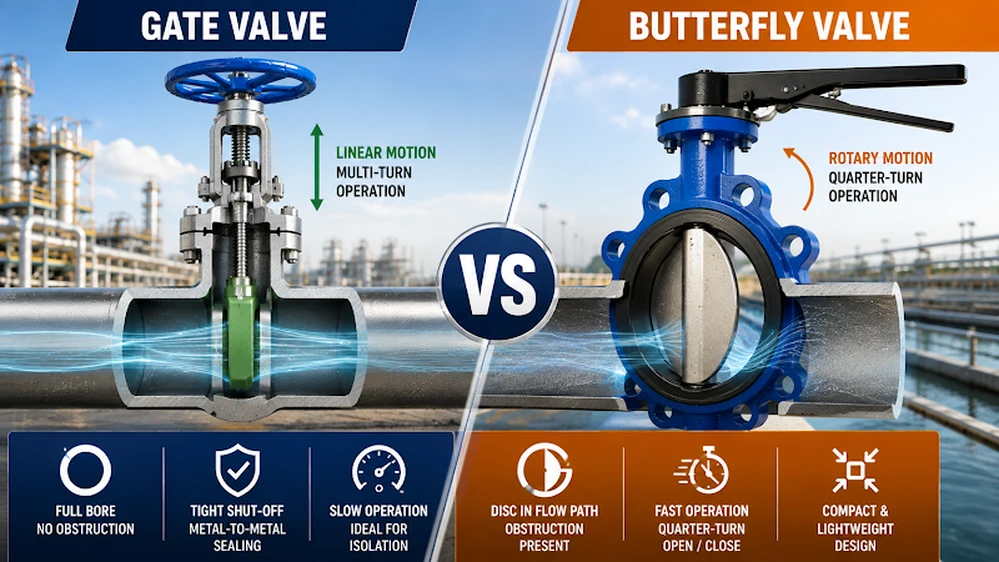
The gate valve vs butterfly valve difference starts with how each valve physically controls flow.
Gate valve: a wedge-shaped disc moves perpendicular to the flow. Multiple stem turns raise or lower it. Fully open means the wedge withdraws completely from the bore. No obstruction. Near-zero pressure drop. Fully closed means metal wedge pressed hard against precision seat rings. Tight shut-off. Slow operation prevents water hammer. If you are evaluating configurations for your project, YKY’s gate valve range covers API and GB standards across full material and pressure class options.
Butterfly valve: a disc on a rotating stem. Quarter-turn open. Quarter-turn closed. Fast. Simple. Compact. The disc never fully leaves the flow path, even at full open. That persistent obstruction is the trade-off for the speed and size advantages the design offers.
How Do Pressure Drop and Flow Performance Compare?
Butterfly valve vs gate valve pressure drop is the most measurable performance difference between the two.
Gate valve fully open: wedge withdrawn from bore completely. Fluid passes straight through. Pressure drop is minimal. That is why gate valves appear on long pipelines and large-diameter headers where energy loss across the valve needs to stay low.
Butterfly valve fully open: disc still sitting in the flow stream. Creates turbulence around the disc edges. Pressure drop is higher than a gate valve at the same pipe size and flow rate. In low-pressure water or HVAC systems that is fine. In high-pressure process lines it becomes a problem that affects system hydraulics.
What Are the Pros and Cons of Each?
Butterfly valve vs gate valve pros cons breaks down cleanly once you look at each design honestly.
Gate valve strengths: metal-to-metal sealing, full-bore flow, high pressure and temperature capability, in-line disc and seat maintenance, wide material range from WCB to Hastelloy.
Gate valve weaknesses: heavier and bulkier than butterfly valves at the same bore, slow multi-turn operation, not suitable for throttling, higher unit cost in large diameters.
Butterfly valve strengths: lightweight and compact, quarter-turn speed, significantly lower cost in large diameters, easy installation where space is tight, works well in low-pressure water and utility service.
Butterfly valve weaknesses: disc always in flow path, elastomeric seats limit temperature and chemical resistance, sealing performance lower than metal-seated gate valves, not suited to slurry or abrasive media.
When Should You Use a Butterfly Valve Instead of a Gate Valve?
When to use butterfly valve instead of gate valve depends on pressure class, diameter, and what the system is handling.
Butterfly valve is the right call for: low-pressure systems below PN16, large-diameter lines where weight and cost are primary constraints and tight sealing is not a critical requirement, water treatment and HVAC where elastomeric seating is acceptable, and tight spaces needing fast operation.
Gate valve is the right call for: high-pressure oil and gas, steam above 200°C, corrosive or toxic chemical media, any service needing bubble-tight metal-to-metal shut-off. For projects requiring full-bore isolation in these conditions, understanding the types of gate valves available helps narrow the specification before requesting a quote.
How Do the Costs Actually Compare?
Gate valve vs butterfly valve cost is not just about the purchase price. Total cost of ownership tells the real story.
Butterfly valves cost less upfront, especially above DN200. Simpler geometry, lighter materials, faster to manufacture. For large-diameter low-pressure systems, that lower price point is justified by the performance on offer.
Gate valves cost more upfront. But disc and seat can be re-machined in-line without pulling the valve from the pipeline. In high-pressure or corrosive service, that in-line maintainability avoids full valve replacement when wear occurs. Over the service life of a demanding application, the gate valve often costs less to keep running than repeatedly replacing a butterfly valve that was never suited to the duty.
The GB Gate Valve is engineered for reliable performance in industrial applications, including chemical, petrochemical, and power industries.
Explore Product
How Do Gate Valve and Butterfly Valve Compare Side by Side?
The table below covers gate valve vs butterfly valve across the factors that matter most for industrial buyer decisions.
| Factor | Gate Valve | Butterfly Valve |
| Sealing | Metal-to-metal, superior | Elastomeric seat, moderate |
| Pressure rating | Up to Class 2500 | Typically PN16 and below |
| Pressure drop | Very low, full bore | Higher, disc in flow path |
| Size and weight | Bulkier, heavier | Compact, lightweight |
| Operation | Slow, multi-turn | Fast, quarter-turn |
| Temperature range | Up to 425°C and above | Limited by seat material |
| Large diameter cost | Higher | Significantly lower |
| Best for | High-pressure isolation, steam, chemical | Low-pressure, water, HVAC |
Why Choose YKY Valve for Gate Valve Supply?

YKY Valve manufactures gate valves for applications where butterfly valves fall short on sealing, pressure, or temperature. Factory-direct. No intermediary markup. API, GB, DIN, and JIS certified. Materials from WCB to CF8M to Hastelloy. 150+ CNC machines. 100% dimensional inspection and pressure testing on every unit.
No strict MOQ. Single-piece samples available. For oil and gas, chemical, and pharmaceutical projects where gate valve vs butterfly valve difference in sealing is the deciding factor, contact YKY Valve for a quotation and free selection consultation.
Frequently Asked Questions
What is the main difference between a gate valve and a butterfly valve?
Gate valves use a wedge disc for full-bore metal-to-metal isolation. Butterfly valves use a rotating disc for fast quarter-turn operation. Gate valves suit high-pressure service. Butterfly valves suit large-diameter low-pressure systems.
Which has lower pressure drop, gate valve or butterfly valve?
Gate valves. The wedge fully withdraws from the bore when open, leaving no obstruction. Butterfly valve discs remain in the flow path at all positions, creating higher turbulence and pressure drop at equivalent pipe size.
Are butterfly valves cheaper than gate valves?
Yes, typically. Lower unit cost especially in large diameters. Gate valves cost more upfront but allow in-line seat repair, reducing lifecycle cost in high-pressure or corrosive service where butterfly valves would need full replacement.
When should I choose a gate valve over a butterfly valve?
High-pressure oil and gas, steam systems, corrosive chemical media, and any application requiring tight metal-to-metal shut-off or full-bore flow with minimal pressure drop. Butterfly valves suit large-diameter low-pressure water and HVAC service.