










Quick Answer
Gate valves serve on/off control in pipelines, with two main stem designs: rising stem (OS&Y) and non-rising stem (NRS). Rising stem valves feature a visible stem that moves up and down, offering clear open/close indication but requiring more vertical space. Non-rising stem valves keep the stem stationary and compact, ideal for underground or confined installations. The choice depends on space availability, visibility needs, and maintenance access, as both types serve the same purpose but cater to different operational conditions.
Gate valves are one of the most common valve types used for on/off control in pipelines. While their main function remains the same, their stem design can differ specifically between rising stem and non-rising stem configurations. Understanding the distinction between these two types helps engineers, plant operators, and procurement specialists choose the right valve for their system requirements.
In this guide, we’ll break down the gate valve rising stem vs non-rising stem comparison in terms of structure, operation, and ideal applications.

Understanding Gate Valve Stem Design
Before comparing the two, it’s important to understand the function of the stem. The stem connects the handwheel or actuator to the valve gate, transmitting torque to lift or lower the gate when opening or closing the valve.1
There are two main types of stem configurations:
- Rising Stem Gate Valve (OS&Y) – “Outside Screw and Yoke” design
- Non-Rising Stem Gate Valve (NRS) – Internal threaded stem design
Each type offers specific mechanical and operational benefits depending on installation space, visibility, and maintenance requirements. Our full selection includes both API Gate Valve and GB Gate Valve options in both stem configurations.

Featuring a rising stem design for clear visual indication. Ideal for oil & gas applications requiring API 600 compliance and safety.
Explore API Standard
Robust GB standard gate valves available in various configurations, suitable for water treatment and industrial pipelines.
Explore GB StandardRising Stem Gate Valve

What Is a Rising Stem Gate Valve?
A rising stem gate valve, also known as an OS&Y gate valve, features a stem that moves upward or downward as the valve is operated. The stem threads are located outside the valve body and are visible above the yoke when the valve opens.2
How It Works
When the handwheel is turned, the stem threads rotate through a fixed nut in the yoke, causing the stem and gate to rise together. This motion provides a visual indication of whether the valve is open or closed.
Key Features
- The stem rises when the valve opens
- Gate and stem move together
- Visible stem position for easy monitoring
- Requires more vertical installation space
Advantages
- Easy visual inspection: Operators can quickly see if the valve is open or closed.
- Smooth operation: External threads prevent contact with fluid, reducing wear and corrosion.3
- Ideal for outdoor and critical systems: Common in fire protection, oil & gas, and power plants.
Disadvantages
- Needs more vertical clearance
- Exposed stem threads may require regular lubrication and protection
Non-Rising Stem Gate Valve
What Is a Non-Rising Stem Gate Valve?
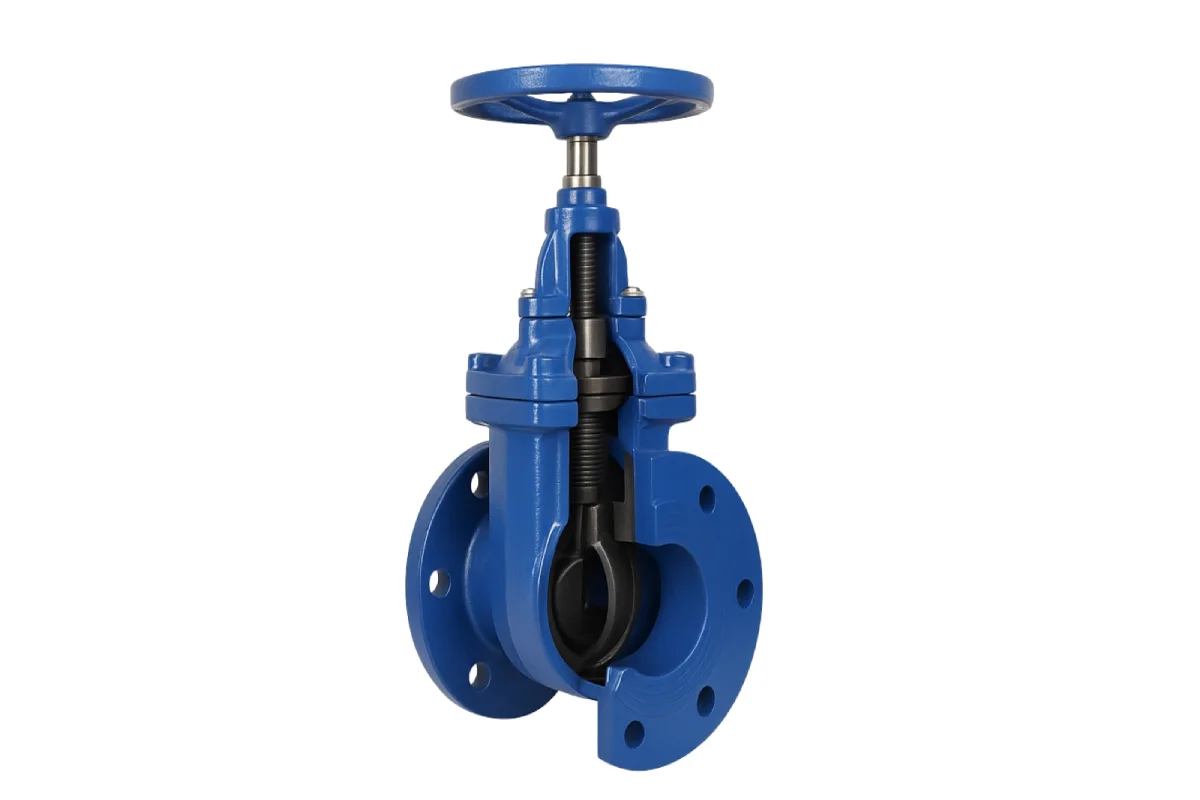
A non-rising stem gate valve (NRS) has its stem threads inside the valve body. The gate moves up and down along the stem, but the stem itself remains stationary.
How It Works
When operated, the stem turns in place, moving the gate internally without extending above the handwheel. Because the stem doesn’t rise, this design is compact and ideal for limited space installations.
Key Features
- The stem does not rise during the operation
- Compact and enclosed design
- No external stem movement
- Suitable for underground or confined spaces
Advantages
- Space-saving design: Perfect for underground pipelines and tight installations.
- Protected threads: The stem threads are inside the valve body, shielded from dust or external damage.
- Low maintenance: Less exposed metal means fewer corrosion issues in certain environments.
Disadvantages
- No visual indication of valve position
- Internal threads may wear faster in high-turbulence media
Gate Valve Rising Stem vs Non-Rising Stem: Key Differences
| Feature | Rising Stem Gate Valve | Non-Rising Stem Gate Valve |
| Stem Movement | The stem rises and lowers during operation | Stem remains stationary |
| Visibility | The open/close position is easily visible | No visual indicator |
| Space Requirement | Requires more vertical space | Compact and space-saving |
| Maintenance | External threads require lubrication | Internal threads protected |
| Applications | Fire systems, power plants, oil & gas | Underground pipelines, waterworks |
Applications and Industry Use
Choosing between a gate valve rising stem vs non-rising stem depends on your working environment and maintenance access.
Rising stem gate valves are commonly used in:
- Fire protection and sprinkler systems
- Power generation facilities
- Oil and gas processing plants (See also What Is An API 600 Gate Valve?)
- Chemical and refinery operations
Non-rising stem gate valves are preferred for:
- Underground or buried pipelines
- Municipal water and wastewater systems
- HVAC and compact mechanical rooms
- Marine and shipbuilding industries
OS&Y Gate Valve vs Non-Rising Stem Gate Valve
The OS&Y gate valve vs non-rising stem comparison highlights one key point: visibility versus compactness.
If you need a clear open/close indication and can afford extra installation space, go for a rising stem design.
If space constraints or underground placement are priorities, a non-rising stem design offers practicality without compromising functionality.4 For long-term performance, proper Comprehensive Valve Testing and Quality Assurance is crucial regardless of stem type.
Conclusion
Understanding the difference between gate valve rising stem vs non-rising stem configurations helps ensure correct selection for your system’s layout, safety, and maintenance needs. Both serve the same purpose but cater to different operational conditions.
Whether you require easy monitoring or compact installation, choosing the right gate valve design will ensure efficiency, safety, and long service life.
Looking for high-quality gate valves for your next project?
Contact YKY Valve today to get expert recommendations and technical support for selecting the ideal valve configuration for your application.
Key Takeaways
- Rising stem gate valves (OS&Y) offer visible operation but require more vertical space.
- Non-rising stem gate valves are compact and ideal for underground use.
- The right choice depends on space availability, visibility, and maintenance access.
FAQs
Q1: What does OS&Y mean in gate valves?
A1: OS&Y stands for “Outside Screw and Yoke.” It refers to a rising stem gate valve where the stem and gate move together, providing visible position indication.
Q2: Which is better: a rising stem or a non-rising stem gate valve?
A2: Neither is inherently better; it depends on your application. Rising stem valves are ideal for easy monitoring, while non-rising stem valves fit tight or underground spaces.
Q3: Can both types be used for the same pressure ratings?
A3: Yes. Both designs can be manufactured for the same pressure classes and materials, complying with standards like API 600 or DIN.
Q4: How can I identify a gate valve’s stem type?
A4: If the stem visibly moves up when opening, it’s a rising stem valve. If it remains stationary, it’s a non-rising stem valve.
Q5: Are rising stem gate valves more expensive?
A5: Generally, yes. Rising stem valves may cost slightly more due to additional materials and external components like the yoke. However, they offer ease of operation and maintenance visibility.