









Quick Answer
Stainless steel ball valves are ideal for corrosive media, high temperatures above 160°C, and sanitary applications, outperforming brass or plastic in demanding environments. They offer superior corrosion resistance, durability, and pressure ratings. Choose 304 grade for general and food processing, and 316 grade for marine and harsh chemical use. Though costlier, their longevity justifies the investment in critical industrial settings.
Use a stainless steel ball valve when your application involves corrosive media, high temperatures above 160°C, or strict hygiene requirements. These valves excel in chemical processing, marine environments, food production, and petroleum refining, where brass or plastic valves would fail. The superior corrosion resistance and strength make the higher cost worthwhile in demanding industrial conditions.
What is a Stainless Steel Ball Valve Used For?
A stainless steel ball valve controls fluid flow using a spherical ball with a central hole. When the hole aligns with the pipeline, fluid passes through. Rotate the ball 90 degrees, and the solid portion blocks the flow completely.
The quarter-turn operation provides quick shut-off capability. Full-bore designs maintain pipe diameter through the valve, minimizing pressure drop during flow. This makes them ideal for applications where both flow rate and pressure matter.
Why Use Stainless Steel Valves?
Stainless steel outperforms brass, plastic, and cast iron in several critical areas. The material consists of at least 50% iron and 10% chromium, which forms a protective oxide layer preventing rust.
Key advantages:
- Corrosion resistance: Withstands acids, alkalis, and saltwater that destroy other materials
- Temperature capability: Operates reliably up to 220°C versus 160°C for brass or 60°C for plastic
- Pressure ratings: Handles up to 130 bar compared to 80 bar for brass or 10 bar for plastic
- Sanitary compliance: Non-porous surface prevents bacterial growth and meets FDA standards
- Durability: Resists wear, scaling, and pitting for decades of service
The main drawback is cost. Stainless steel ball valves cost more than brass or plastic alternatives. However, the higher price reflects superior performance in harsh conditions where cheaper materials fail quickly.
When Should You Choose 304 vs 316 Stainless Steel?
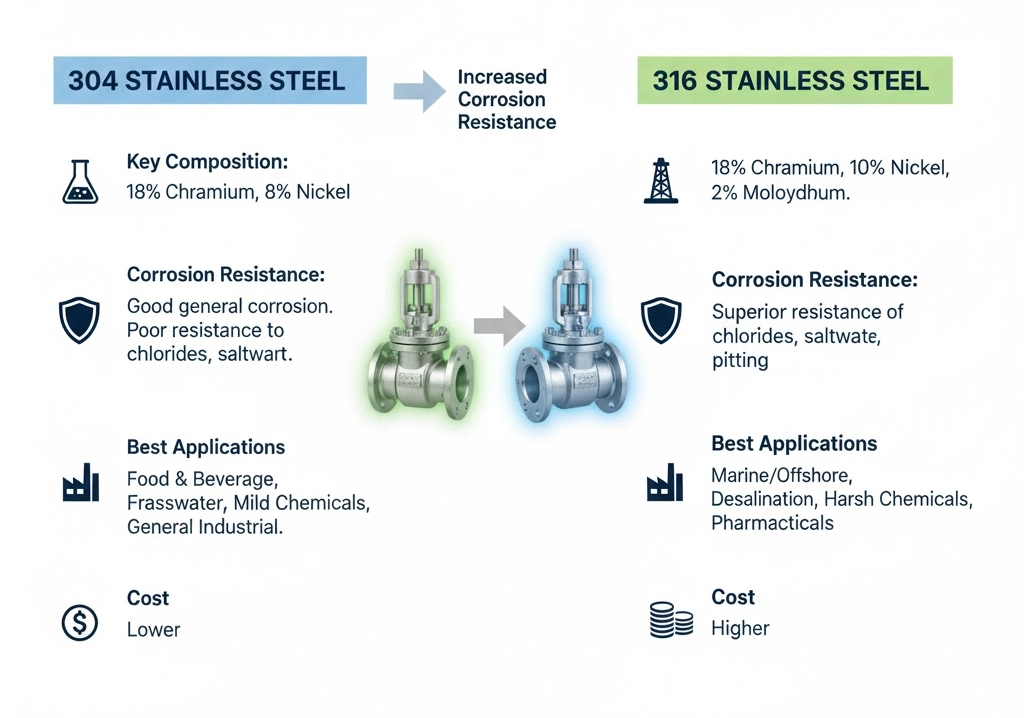
The two common grades differ in corrosion resistance and cost.
304 Stainless Steel Ball Valve
A 304 stainless steel ball valve contains 18% chromium and 8% nickel. This composition provides good general corrosion resistance at a lower price point than 316 grade.
Best applications include:
- Food and beverage processing
- General-purpose industrial use
- Freshwater systems
- Indoor chemical processing with mild acids
The material handles most environments well but struggles with chloride exposure and marine conditions.
316 Stainless Steel Ball Valve
A 316 stainless steel ball valve adds 2% molybdenum to the 304 composition. This molybdenum dramatically improves resistance to chlorides and pitting corrosion.
Best applications include:
- Seawater and marine environments
- Desalination plants
- Pharmaceutical production
- Harsh chemical processing
- Offshore platforms
Choose 316 grade whenever chlorides, saltwater, or aggressive chemicals are present. The extra cost pays off through longer service life.
Premium 3-piece flanged forged ball valve for superior performance in high-pressure and critical industrial applications. Easy maintenance and robust design.
Explore Product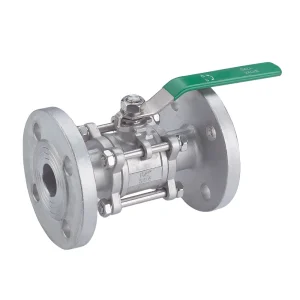
What Are The Main Types of Stainless Steel Ball Valves?
Different configurations suit different installation and maintenance needs.
3 Piece Stainless Steel Ball Valve
A 3 piece stainless steel ball valve consists of a center body with two end caps. You can disassemble it for maintenance or seal replacement without removing the entire valve from the pipeline.
This design is popular in brewing systems and chemical plants where regular cleaning is necessary. You can service the valve in place, which cuts downtime and maintenance costs.
Flanged Stainless Steel Ball Valve
The flanged stainless steel ball valve uses bolted flange connections on both ends. These create robust, leak-resistant joints for high-pressure industrial piping systems.
Flanged stainless steel ball valves typically start at 2-inch sizes and larger. They’re common in chemical processing, petroleum refining, and water treatment facilities. The bolted connection allows for easy removal and replacement during maintenance.
High Pressure Stainless Steel Ball Valve
A high pressure stainless steel ball valve is rated for demanding conditions. These valves handle extreme pressures, with some models rated for 3000 psi (approximately 207 bar). They’re suitable for hydraulic systems, offshore operations, and high-pressure chemical processes.
These valves use reinforced body construction and premium seal materials. Verify the pressure rating exceeds your system’s maximum operating pressure with an adequate safety margin.
Stainless Steel 2 Way Ball Valves
Stainless steel 2 way ball valves have two ports (inlet and outlet) for simple on/off control. They provide reliable isolation service in chemical transfer lines, sampling systems, and process equipment shutdowns.
The straightforward design makes them economical and easy to operate. They’re the most common configuration across all industries.
Where Are Stainless Steel Ball Valves Most Commonly Used?
These valves appear in applications where material performance is critical:
- Seawater and marine environments: Desalination plants, offshore platforms, and ship systems require 316 grade stainless steel to resist saltwater corrosion. High pressures and extreme temperatures demand the strength that plastic valves cannot provide.
- Brewing systems: Breweries use stainless steel ball valves on kettles to control wort transfer. The liquid extracted during mashing is corrosive and hot. A 3 piece stainless steel ball valve allows easy cleaning between batches.
- Chemical processing: Plants handling acids, bases, and harsh salts need corrosion-resistant materials. Stainless steel controls flow for chemical transfer, mixing, and blending operations that would destroy brass or iron.
- Food and beverage production: Dairy processing, bottling lines, and food manufacturing require sanitary equipment. The smooth, non-porous surface prevents contamination and facilitates CIP procedures while meeting FDA requirements.
- Petroleum refining: Crude oil contains water, carbon dioxide, sulfur, and microorganisms that make it highly corrosive. Stainless steel ball valves last longer than other materials, reducing replacement frequency and downtime.
How Do You Source Quality Stainless Steel Ball Valves?
When evaluating suppliers, verify material grades through mill test reports. These documents confirm that the actual chemical composition matches specifications for 304 or 316 stainless steel.
Look for certifications like ISO 9001, API, and industry-specific standards. These ensure dimensional accuracy, pressure testing, and quality control during manufacturing.
Many buyers source from manufacturers in China producing stainless steel ball valves for competitive pricing. Chinese suppliers now maintain international quality standards through third-party testing. Verify the manufacturer provides English-language technical support and complete documentation.
YKY Valve manufactures certified stainless steel ball valves in multiple configurations. Our flanged forged ball valve handles sizes DN50 to DN600 with pressure ratings up to PN160. For threaded applications, the thread ball valve offers NPT and BSP connections in DN6 to DN100 sizes.
Both product lines use CF8 (304) or CF8M (316) stainless steel bodies with customizable seat materials. Browse our complete product catalog for specifications and technical support.
How Should You Install and Maintain Stainless Steel Ball Valves?
Install valves with the handle accessible for operation and maintenance. Ensure proper pipe support on both sides to prevent stress on the valve body.
Apply thread sealant or use proper gaskets based on your connection type and media. For flanged connections, follow the manufacturer’s torque specifications and bolt tightening sequence.
Operate the valve slowly to avoid water hammer. Rapid closure creates pressure spikes that can damage piping and equipment. Cycle the valve periodically, even if it usually stays in one position to prevent seat sticking.
During regular maintenance, inspect for leaks around the stem packing. Minor leaks can often be stopped by tightening the packing nut. If the adjustment no longer controls leakage, replace the packing.
What Should You Know When Choosing Stainless Steel Ball Valves?
Choose stainless steel ball valves when corrosion resistance, high temperature capability, or sanitary requirements matter more than upfront cost. These valves outperform brass and plastic in demanding industrial applications.
When selecting your valve:
- Use 304 grade for food processing and general industrial applications
- Use 316 grade for marine environments and harsh chemicals
- Choose 3-piece designs when regular maintenance is needed
- Verify pressure ratings exceed your system requirements
- Request mill test reports confirming material composition
These valves work well in chemical processing, brewing, petroleum refining, and food production. The higher initial investment returns value through longer service life and less maintenance in corrosive or high-temperature conditions.