










Selecting the right gate valve for steam applications is essential for ensuring safety and efficiency throughout the industrial process. They are usually preferred in such settings thanks to their ability to provide a tight seal and efficiently handle high-pressure environments caused by thermal expansion and erosion.
By this, engineers mainly focus on material durability and seat design. This guide explores the technical requirements for choosing a steam gate valve.
Understanding Steam Service Challenges
Before proceeding into the selection process, it is important to understand the specific requirements of your high-pressure steam application. Steam is a demanding medium for any valve as it carries high kinetic energy that can erode internal parts. This involves factors such as maximum operating pressure, temperature, and steam type (saturated or superheated).
Pressure drops in steam lines can cause wire-drawing, where fast-moving steam erodes the valve seat. Even a small leak can quickly worsen, thus engineers focus on tight shut-off to prevent damage.
Temperature fluctuations also cause metal components to expand and contact. This movement often leads to sticking or thermal binding, and a gate valve for steam service must handle these stresses without leaking.
Moreover, understanding the differences between the types of steam is crucial. Saturated steam is dense and erosive, while superheated steam is a dry gas. Accurately identifying the steam will affect everything from the needed flow capacity (Cv) to the choice of material.
Bolted Bonnet Steel Gate Valves for the petroleum and natural gas industries, designed for reliable performance in harsh conditions.
Explore Product
Material Selection
There is a wide range of steam valve materials, each suited for different applications. For high-pressure steam, you need materials that can handle both the pressure and thermal stress.
Carbon steels (like ASTM A216 WCB) are effective for temperatures ranging -20°F (-29°C) to 800°F (425°C). It offers a good strength and is an affordable option for many plants. However, as temperature rises, carbon steel loses its mechanical properties and may suffer from carbonization over long periods.
For higher temperatures, alloy steels like chrome-moly (ASTM A217 WC6 or WC9) are recommended. Though their valve trim must be hardened, they resist long-term deformation and oxidation better than standard carbon steel. Choosing the right material is vital for a high temperature steam valve to prevent weariness and reduce maintenance costs.
Design and Construction
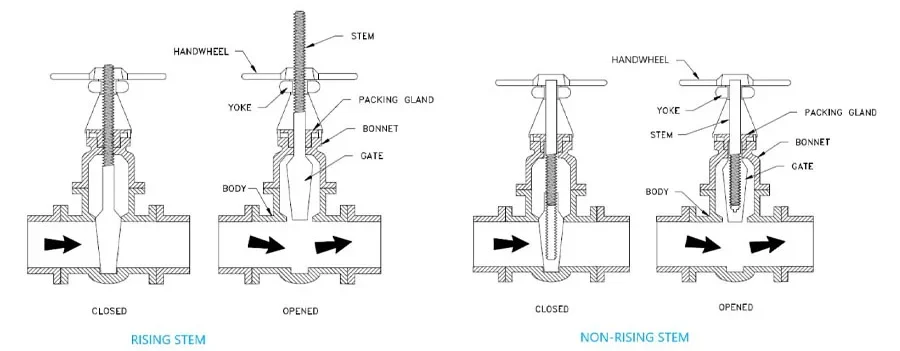
Gate valves come in different designs, such as rising and non-rising stem types. Selecting the right one is crucial as it affects how well the valve can handle pressure fluctuations.
Rising stem (Outside Screw and Yoke or OS&Y) gate valves feature a stem that movies upward upon opening that helps provide clear, detailed visual position indication. They are commonly used for high-pressure steam thanks to their durability and ease of maintenance, though they need more vertical space.
In contrast, non-rising stem (NRS or Inside Screw) valves keep the stem stationary. Although they cannot easily show the position of the valve, they are portable and suitable for tight spaces, water, or underground settings.
Size and Pressure Rating
Proper sizing is crucial for gate valves in high-pressure steam systems. If a valve is too small, it may struggle to handle the system’s pressure and leads to potential damage or operational issues. On the other hand, an oversized valve can cause flow inefficiencies and increased costs, making careful selection essential for optimal performance.
Compliance and Testing Standards
A steam gate valve must meet specific industry standards and certifications, as they are more likely to perform reliably under high-pressure and high-temperature settings.
The API 600 standard governs the design of heavy-duty gate valves, specifying the wall thicknesses and stem diameters for maximum safety. Moreover, ASME B16.34 defines the pressure-temperature ratings for different materials. Following these standards ensures the valve can handle the rated load.
Testing is also essential for verifying performance. For instance, hydrostatic tests check the body for leaks under high pressure, while seat leakage tests ensure the valve provides a tight shut-off. Buyers should request material test reports (MTRs) for all pressure-retaining parts to prove the chemical composition of the steel used.
Red Flags in Supplier Selection
Not all manufacturers understand the needed details of steam service. Here some common red flags that you need to avoid:
- The use of soft-seated valves for steam, like PTFE, which easily melt at typical steam temperatures.
- Lack of certificates, such as ISO 9001 or CE. This highlights their inconsistency in quality control.
- Suppliers who cannot provide detailed technical drawings and documents that show the exact materials used.
- No experience in power plant applications.
Conclusion
Selecting a gate valve for steam heavily relies on understanding your specific requirements, material durability and design efficiency, ensuring compliance with standards, and working with the right suppliers. Following these helps safety, prevent erosion, and structural failure in the long run.
YKY provides a wide range of gate valves specifically designed for demanding steam applications, including oil, water, gas, and chemical pipelines. Our products are also available in both rising and non-rising stem designs with API, DIN, and JIS options.
With industry certifications including ISO 9001 and CE, we provide the documentation needed for critical boiler and power plant applications. YKY’s commitment to precise engineering helps operators reduce downtime and improve system safety.