









Quick Answer
The 2-piece ball valve offers full-port flow and partial in-line maintenance via a threaded end insert, balancing leak-path minimization with repairability. Choosing the right configuration depends on maintenance needs, while material, pressure rating, and connection standards must match the specific application. Correct selection prevents pressure loss, corrosion, and surge-related failures in high-pressure industrial systems.
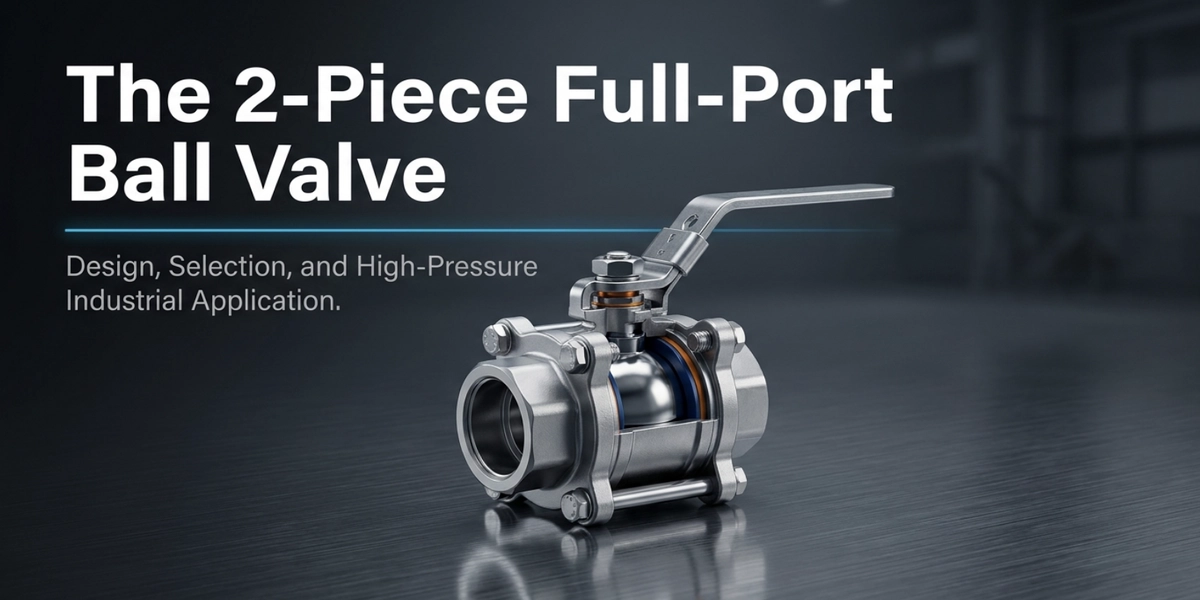
A chemical plant running aggressive solvents through a reduced-bore valve loses pressure efficiency at every cycle. An oil and gas facility that selects the wrong body configuration pays for it during the first unplanned maintenance event — when the valve cannot be serviced in-line and the entire section goes offline.
The 2 piece ball valve solves both problems: full-port bore eliminates flow restriction, and the two-section body allows seat and seal replacement without scrapping the valve. This guide covers the structural logic behind that design, how it compares to alternative configurations, and what parameters drive correct selection for high-pressure industrial service.
How the 2 Piece Ball Valve Body Structure Controls Flow and Leakage
The 2-piece ball valve consists of a main body and one threaded end insert. The end insert houses the ball, seats, and stem seal, and threads into the main body to create a single internal joint. That single joint is the structural advantage: fewer assembly interfaces mean fewer potential leak paths under pressure cycling.
The full-port bore matches the internal diameter of the connected pipe exactly. Fluid passes through without the contraction and expansion that reduced-bore designs create at each valve entry and exit. In high-flow hydraulic circuits and gas distribution lines, that pressure drop difference is measurable and operationally significant.
YKY machines all 2-piece body joints to ISO 5208 air-tightness standards using CNC equipment, maintaining dimensional consistency across high-volume production batches.
1-Piece vs. 2-Piece vs. 3-Piece: Choosing the Right Body Configuration
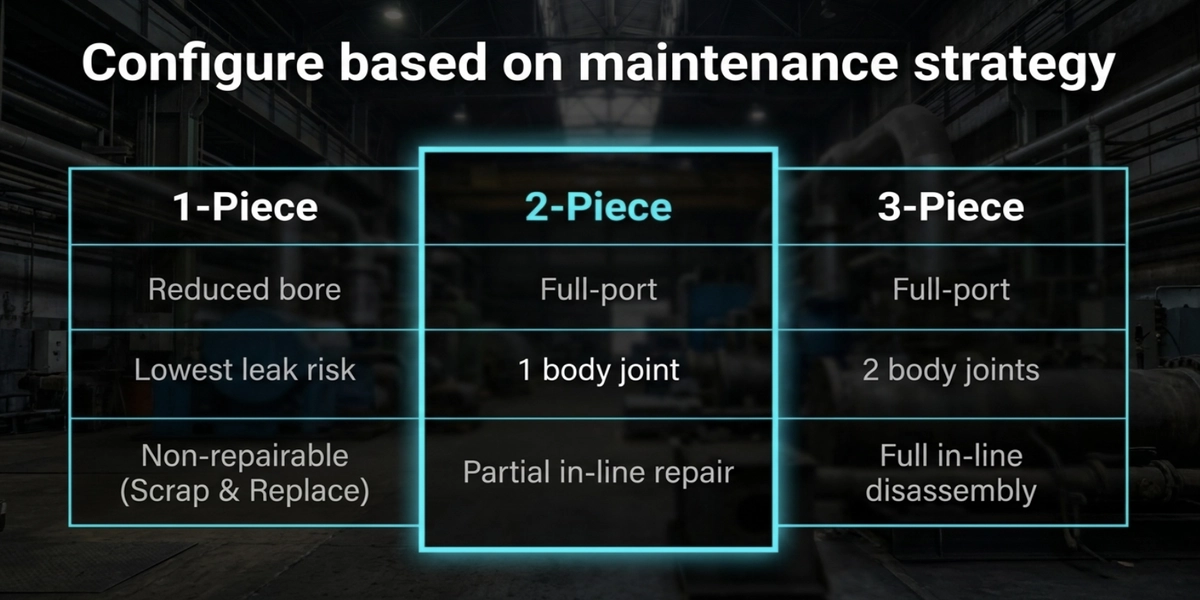
Body configuration determines maintenance strategy, not just assembly complexity. Each design serves a specific operational context:
| Feature | 1-Piece | 2-Piece | 3-Piece |
| Bore Type | Reduced-bore only | Full-port available | Full-port available |
| Leakage Paths | Fewest | One body joint | Two body joints |
| In-Line Maintenance | Not possible | Partial (end insert) | Full (remove body) |
| Repairability | Non-repairable | Seat/seal replacement | Full in-line service |
| Typical Application | Low-pressure utilities | Industrial process lines | High-maintenance circuits |
| Relative Cost | Lowest | Mid-range | Highest |
One-piece valves are non-repairable. When the seat wears, the valve is replaced. Two-piece valves allow seat and seal replacement by removing the end insert — the valve body stays in the line. Three-piece valves go further: both end caps remove independently, allowing full in-line disassembly without disconnecting pipe ends.
The 3-piece design adds a second body joint, which introduces an additional potential leak path. For systems where maintenance frequency is low and leak-path minimization is the priority, the 2-piece configuration is the correct balance.
Flow Direction, Installation Orientation, and Connection Standards
The 2-piece ball valve operates bidirectionally — fluid enters from either end under standard conditions. For high-pressure oilfield service, manufacturers’ technical drawings specify a preferred flow direction that loads the downstream seat rather than the upstream seat, extending service life. Always verify orientation against the valve drawing before installation.
Connection type follows pipe size and system pressure. Threaded connections — including BSPT for European and Asian infrastructure — handle smaller pipe diameters where compact footprint and installation speed matter. Flanged connections carry larger-diameter pipelines where bolt-pattern stability resists vibration-induced loosening over long service periods.
Because international projects mix infrastructure built to different regional standards, verifying thread compatibility before ordering is not optional. A BSPT threaded valve body installed into an NPT tapped manifold creates a structurally compromised joint that fails under pressure regardless of how tightly the fittings are torqued.
Material Selection Across Operating Environments
Body material determines service life in aggressive environments. The wrong material does not gradually degrade — it fails at the first exposure event that exceeds its resistance threshold.
| Property | 316L Stainless Steel | Carbon Steel / Forged Steel |
| Primary Industries | Pharmaceutical, food, chemical | Oil & gas, metallurgy, power |
| Max Temperature | Up to 600°C (with appropriate seals) | Up to 800°C (4130 forged steel) |
| Corrosion Resistance | Excellent; Hastelloy available for aggressive media | Standard; degrades in salt-spray without coating |
| Surface Finish | ≤0.8μm electro-polished for GMP compliance | Standard industrial finish |
| Certifications | ISO 5208, GMP, FDA-compliant | API 6D, API 600 |
| Cleaning Protocol | CIP/SIP compatible | Standard industrial procedures |
Offshore platforms running carbon steel valves in salt-spray environments see accelerated corrosion within months. Pharmaceutical utilities require 316L stainless with electro-polished internals — the surface roughness specification exists to prevent microbial contamination during CIP cleaning cycles, not for aesthetic reasons.
Metallurgy lines running above 400°C require 4130 forged steel with electric furnace quench treatment; standard cast steel bodies crack under repeated thermal shock at those temperatures.
How Do You Choose the Right 2-Piece Ball Valve for High-Pressure Systems?
Select based on pressure rating, material grade, and connection type matched to the actual operating conditions. For high-pressure oilfield service, specify API 6D certification and confirm the valve is rated for maximum surge pressure — not just steady-state operating pressure. For corrosive chemical lines, specify Hastelloy or PTFE-lined bodies. Thread standard must match existing infrastructure exactly.
The pressure rating on the valve specification must exceed the maximum surge pressure the hydraulic pump generates. Surge events in industrial hydraulic circuits routinely reach 1.5× to 2× steady-state pressure. A valve rated at operating pressure fails during the first high-demand cycle.
Pre-Specification Checklist for 2-Piece Full-Port Ball Valves
Confirm these parameters before placing any order:
- Bore type: Full-port design confirmed — zero flow restriction at the valve body
- Pressure rating: Rated above maximum surge pressure, not steady-state operating pressure
- Material grade: Body and seat material verified against the specific media and temperature range
- Connection standard: Thread type (BSPT, NPT, flanged) confirmed against existing infrastructure
- Actuation mode: Manual, pneumatic, or electric actuation matched to automation requirements
- Certifications: API 6D for oil and gas; ISO 9001 for general quality; GMP for pharmaceutical and food service
YKY Valve supplies 2-piece full-port ball valves in 316L stainless, carbon steel, Hastelloy, and 4130 forged steel — covering pressure ratings from 2,000 PSI standard service through 7,250 PSI high-pressure hydraulic applications. All valves ship with CNC-machined body joints, ISO 5208 pressure test documentation, and full CAD drawings. Standard lead time is 35 days with 99% on-time delivery to 30+ countries.
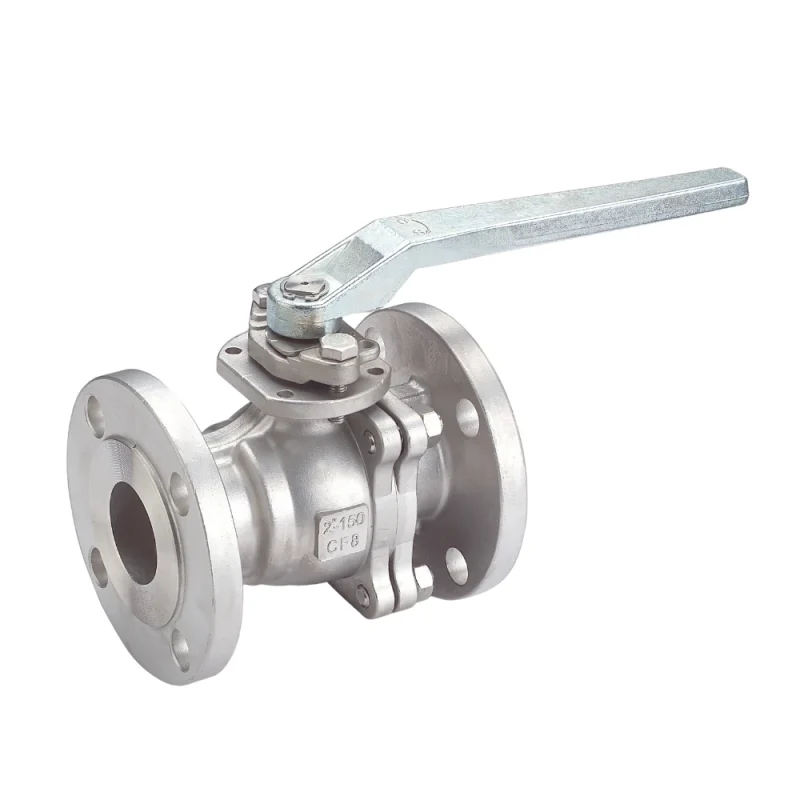
2PC Flanged Ball Valve
Designed for chemical and industrial systems, this 2PC flanged ball valve provides reliable shut-off for corrosive media such as acids, with stable sealing performance.
- Size: DN15 – DN200
- Pressure: PN16 – PN64 / Class 150 – 600
- Body Material: Stainless Steel & Carbon Steel
- Seat: PTFE / RPTFE / PEEK
- Connection: RF, RTJ Flanged
- Temperature: -29°C to 121°C
Frequently Asked Questions
Can a 2-piece ball valve be repaired in-line, or does it need to be removed from the pipe?
Partial in-line repair is possible. Removing the end insert gives access to the ball and seats without disconnecting the main body from the pipeline. Full seat replacement and seal kit installation happen with the body remaining in position. Complete disassembly — for ball inspection or body cleaning — requires removing the valve from the line. For systems where full in-line serviceability is a hard requirement, a 3-piece configuration is the correct specification.
What does full-port mean on a ball valve, and does it matter for my system?
Full-port means the bore through the ball matches the internal diameter of the connected pipe. Reduced-port designs narrow the flow path at the valve body, creating a measurable pressure drop and increased fluid velocity at that point. In low-flow utility systems, the difference is negligible. In high-flow hydraulic circuits, chemical feed lines, and gas distribution systems, the pressure drop across a reduced-port valve accumulates operational cost over time. Full-port is the correct specification wherever flow efficiency is a design parameter.
What is the maximum pressure rating for industrial 2-piece ball valves?
Standard industrial 2-piece ball valves carry pressure ratings up to 2,000 PSI for general oil, gas, and chemical service. High-pressure barstock body series, manufactured in forged carbon or alloy steel, handle up to 7,250 PSI — the specification for hydraulic press systems and high-force actuator circuits where standard valves fail during surge events. The rated pressure on the valve specification must be verified against maximum surge pressure in the circuit, not the system’s steady-state operating pressure.