










Quick Answer
A pipeline project spanning three continents relies on correct thread standards, as mismatched BSPT and NPT threads cause failures under pressure. BSPT valves, with a 55-degree angle, are mandatory for European, Asian, and Australian infrastructure. Selection must verify thread geometry, material compatibility, and pressure ratings to ensure integrity.
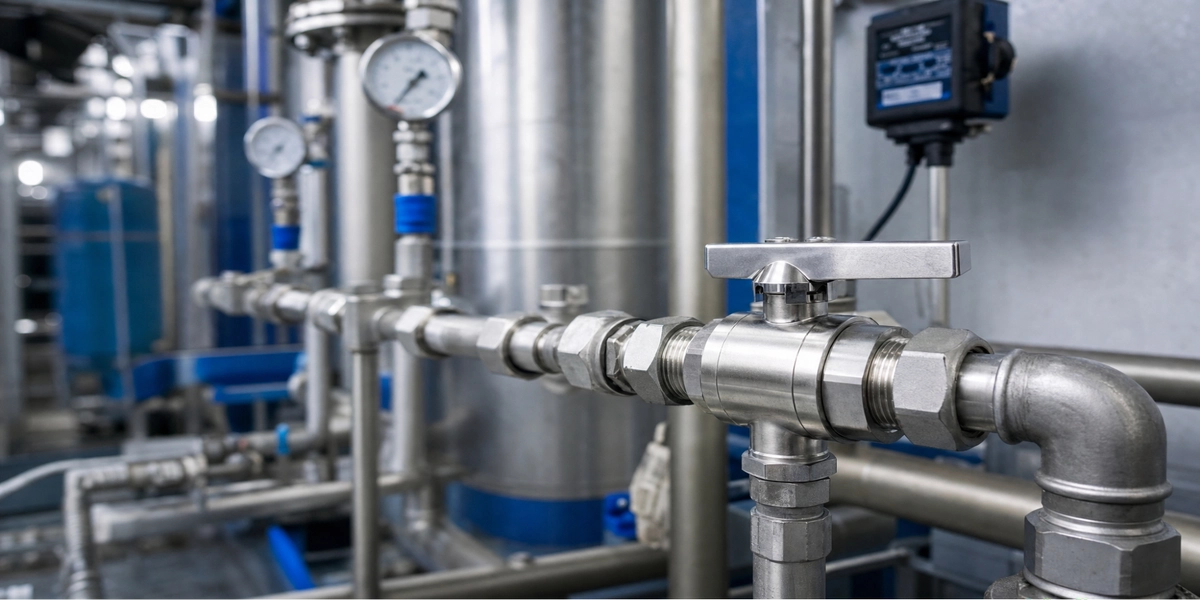
A pipeline project spanning three continents runs on the assumption that every threaded connection meets the regional standard specified in the engineering drawings. When a procurement team sources valves without verifying thread geometry — substituting NPT components into a BSPT system because the dimensions looked close enough — the failure does not appear during installation.
It appears six weeks later, under full operating pressure, at a joint that was never properly seated. This guide covers when a BSPT ball valve is the mandatory specification, how to identify British taper threads in the field, and what material and pressure parameters determine the right valve for European, Asian, and Australian pipeline infrastructure.
Why Thread Standard Selection Determines Pipeline Integrity
A single thread mismatch in a pressurized pipeline does not produce a slow drip — it produces a structural failure point that grows under every pressure cycle. BSPT ball valves use British Standard Pipe Taper threads with a 55-degree flank angle and rounded roots and crests. These valves are the required specification across pipeline infrastructure in Europe, Asia, and Australia that follows British standards.
Procurement teams that source by price alone, without verifying thread geometry, trigger the exact failures that halt production lines and invite regulatory inspection.
BSPT vs. NPT: The Thread Geometry Difference That Cannot Be Ignored
Both NPT and BSPT threads are tapered. Both create a mechanical seal through thread interference. That surface similarity is what causes engineers to assume they are interchangeable — and that assumption is responsible for a significant share of threaded joint failures in cross-border pipeline projects.
The difference is precise and non-negotiable:
| Feature | BSPT (British Standard) | NPT (American Standard) |
| Thread Angle | 55 degrees | 60 degrees |
| Thread Form | Rounded roots and crests | Flattened roots and crests |
| Primary Regions | Europe, Asia, Australia | North America, South America |
| Sealing Method | Taper-to-taper interference | Taper-to-taper interference |
| Interchangeable? | No | No |
A 60-degree NPT male thread forced into a 55-degree BSPT female port creates microscopic gaps along the entire engagement length. The connection may feel tight at installation. Under operating pressure, those gaps propagate. Fluids escape. On a chemical synthesis line, that means a hazmat response. On an offshore platform, it means an emergency shutdown. The thread angle difference of five degrees carries serious operational consequences.
For dimensional and testing standards on industrial pipe threads, the British Standards Institution (BSI) and ASME B1.20.1 are the authoritative references.
How to Identify a BSPT Ball Valve in the Field
A BSPT thread has a 55-degree flank angle, rounded peaks and valleys, and a measurable taper toward the pipe end. Verify using a calibrated thread gauge, cross-reference with project documentation specifying the regional standard, and check the valve body markings for BS or EN designations. Never rely on visual estimation alone.
Technicians working on international projects frequently encounter unlabeled legacy fittings. The identification process is straightforward when executed correctly:
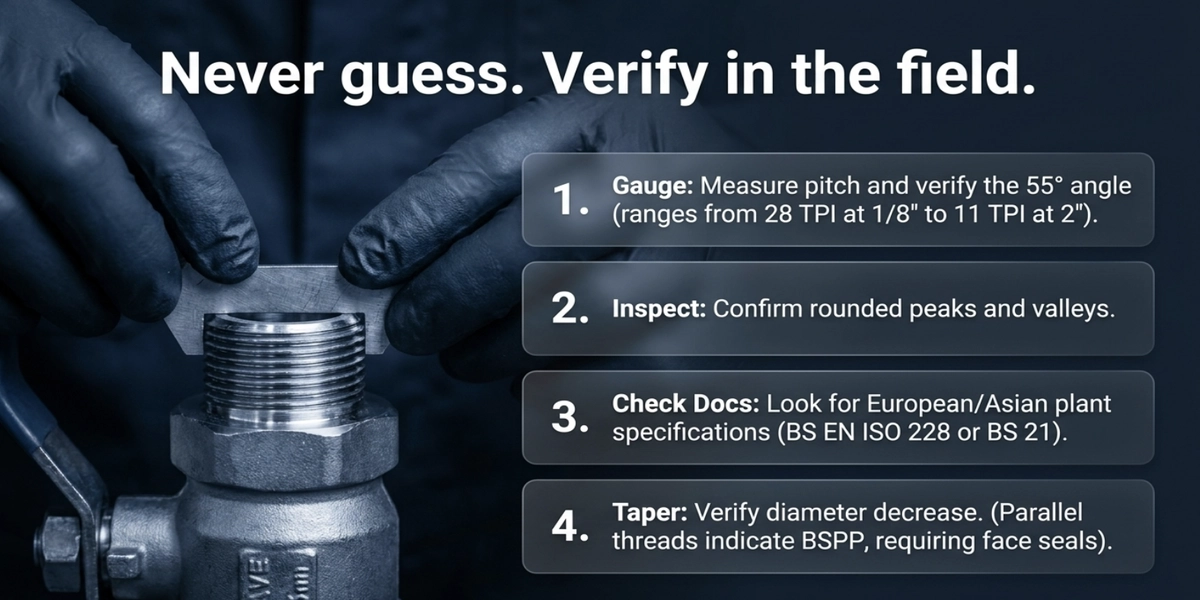
Use a thread gauge first. Measure the pitch and flank angle. BSPT threads range from 28 TPI at 1/8″ to 11 TPI at 2″, with the 55-degree angle consistent across all sizes.
Inspect the thread form. Rounded peaks and valleys confirm British standard geometry. Flattened profiles indicate NPT.
Check project drawings. Manufacturing origin and regional standards appear on original equipment documentation. European and Asian plant drawings specify BS EN ISO 228 or BS 21 — these require BSPT connections.
Verify the taper direction. Diameter decreases toward the pipe end on all tapered standards. A parallel thread with no taper indicates BSPP — a separate British standard requiring a face seal, not thread interference.
Selection Criteria for International Pipeline Projects
Geography determines the thread standard. Any facility built to European or Asian specifications uses BSPT connections throughout — heat exchangers, pump inlets, instrumentation taps, and isolation valves. Substituting NPT components into that infrastructure creates incompatibility at every threaded joint.
Beyond the thread standard, three additional parameters drive material selection:
Operating temperature. Metallurgy and smelting applications subject valves to thermal shock cycles reaching 800°C. Standard cast steel bodies crack under repeated thermal cycling above 400°C. These applications require 4130 forged steel bodies with electric furnace quench treatment to maintain structural integrity across the full temperature range.
Media compatibility. Offshore salt-spray environments corrode carbon steel bodies within months. Pharmaceutical and food processing lines require 316L stainless steel with electro-polished internals at ≤0.8μm surface roughness to meet GMP requirements. Chlorine and ammonia synthesis circuits require Hastelloy C-276 or PTFE-lined bodies — carbon steel in those applications fails before the first scheduled maintenance interval.
Pressure rating. The valve specification must exceed maximum surge pressure, not steady-state operating pressure. Hydraulic surge events reach 1.5× to 2× normal operating pressure. A valve rated exactly at operating pressure fails during the first high-demand cycle.
YKY manufactures BSPT ball valves in carbon steel, 316L stainless, Hastelloy, PTFE-lined, and 4130 forged steel — covering the full spectrum of pressure ratings from standard 2,000 PSI service through 7,250 PSI high-pressure applications. Every valve ships with CNC-machined threads held to ISO and EN tolerances, CAD documentation, and lab pressure test data. Delivery runs on a 35-day standard lead time with a 99% on-time rate across 30+ countries.
The GB Gate Valve is engineered for reliable performance in industrial applications, including chemical, petrochemical, and power industries.
Explore Product
Frequently Asked Questions
Can BSPT and NPT threads ever be used together with an adapter?
Thread adapters exist, but they introduce an additional potential leak point at every joint. In high-pressure hydraulic circuits or chemical lines, that added joint represents an unacceptable risk. The correct approach for international projects is to specify the thread standard that matches the existing infrastructure from the outset — not to adapt around a mismatch after the fact.
What is the difference between BSPT and BSPP threads?
BSPT (British Standard Pipe Taper) threads seal through taper-to-taper interference, the same sealing principle as NPT. BSPP (British Standard Pipe Parallel) threads are straight — they do not taper — and require a bonded seal or O-ring at the face to achieve a pressure-tight joint. Mixing the two creates an incomplete seal regardless of torque applied. Always verify taper versus parallel before ordering replacement valves for British-standard systems.
What certifications should a BSPT ball valve carry for oil and gas applications?
API 6D certification covers pipeline ball valves for oil and gas service and confirms the valve has passed pressure testing, dimensional verification, and material traceability requirements. ISO 9001 covers the manufacturer’s quality management system. ISO 5208 covers pressure testing for industrial valves. For offshore applications, additionally verify compliance with relevant regional authority requirements — ATEX for European explosive atmospheres, for example. Sourcing from a manufacturer holding these certifications eliminates the documentation gaps that delay project approvals.